Collins Line
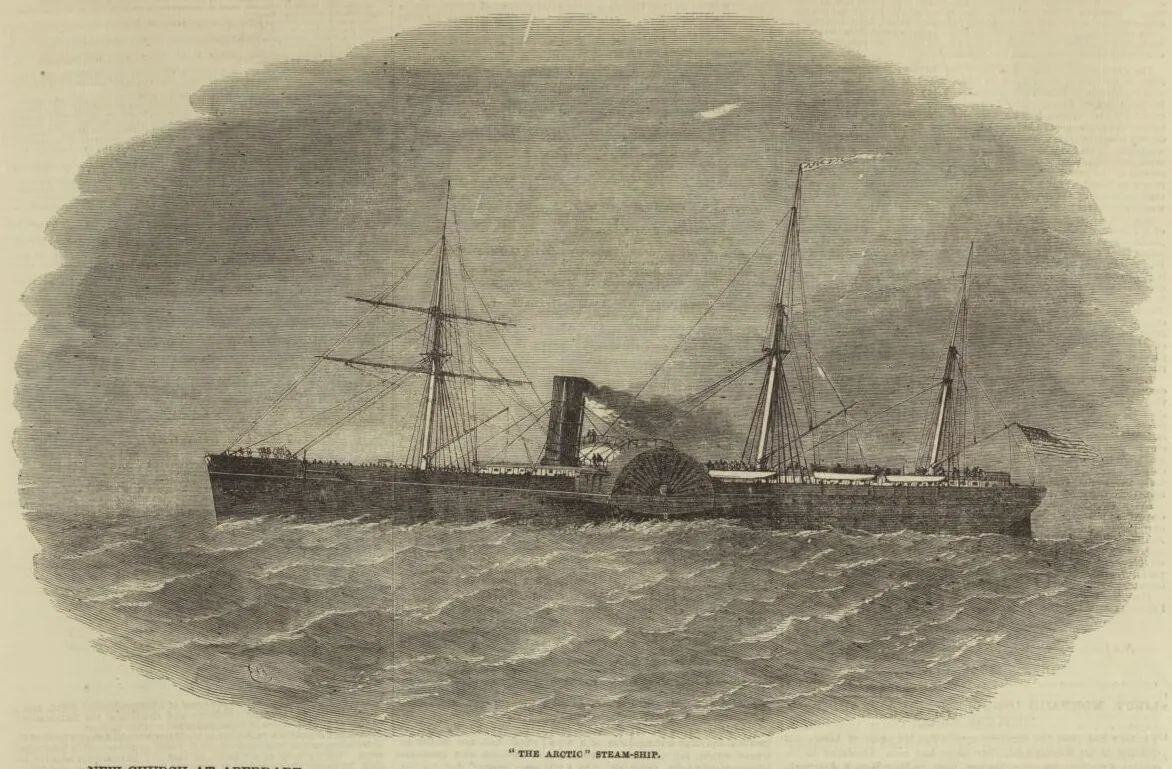
SS Arctic
American transatlantic passenger and mail steamship (1850s)
History
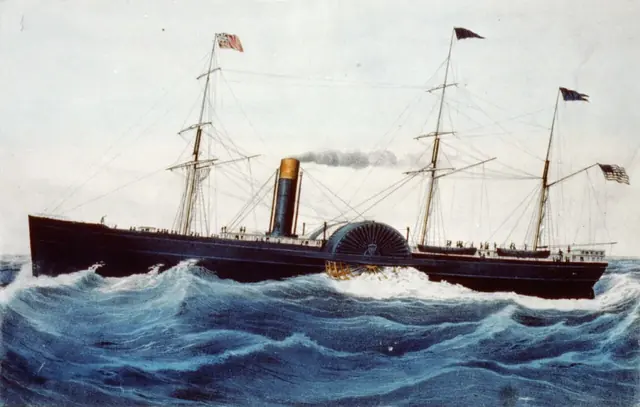
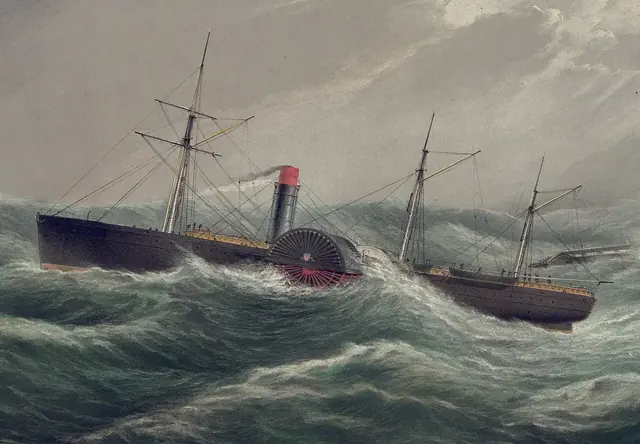
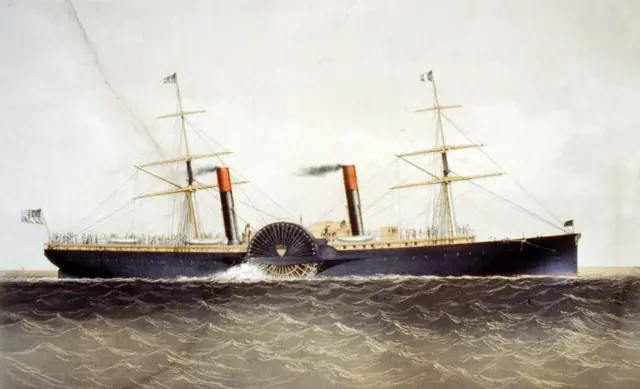
SS Arctic was a 2,856-ton paddle steamer, which was one of the few Collins Line liners, which operated a transatlantic passenger and mail steamship service during the 1850s. She was the largest of a fleet of four, built with the aid of U.S. government subsidies to challenge the transatlantic supremacy of the British-backed Cunard Line. During her four-year period of service, the ship was renowned both for her speed and for the luxury of her accommodation.
On September 27, 1854, while on passage to New York from Liverpool, the Arctic collided in fog with the French steamer SS Vesta, a ship with little to no background, off the coast of Newfoundland, and sank four hours later. The Arctics lifeboat capacity was around 180, enough for fewer than half those on board; the boats were launched in an atmosphere of panic and disorder, and the principle of "women and children first" was ignored. From around 400 on board (250 passengers, 150 crew), 24 male passengers and 64 crew survived; all the women and children died. No one was called to account for the disaster, and no official enquiry was held. Lifeboat provision on passenger-carrying ships remained inadequate until well into the 20th century.
The first shipping line to begin regular transatlantic steamer services was the British-backed Cunard Line, which began operating on July 4, 1840, with the departure from Liverpool of RMS Britannia, bound for Halifax, Nova Scotia, and Boston. As the principal transatlantic mail carrier, the Cunard Line received subsidies from the British government and from the United States Post Office Department; many Americans, however, thought that an American line should benefit from these subsidies. Thus, in 1845, the United States Postmaster General asked shipowners to tender for the right to operate a subsidized passenger and mail service between the U.S. and Europe. The successful bidder, announced on March 3, 1847, was Edward Knight Collins. On the basis of the mail contract Collins founded the New York and Liverpool United States' Mail Steamship Company, familiarly known as the Collins Line, and begin an ambitious steamship construction program.
The William H. Brown and the Jacob Bell shipyards were each contracted to build two large wooden paddle steamers, for use by Collins in a regular twice-monthly transatlantic mail service. The Collins line would receive an annual subsidy, initially of $385,000 a year, from the U.S. government. Part of the government's interest in the project lay in the potential of these ships for use in times of war; they were constructed in a manner that facilitated rapid conversion to warships should the need arise. Arctic, built at Brown's shipyard and designed by George Steers, was the third of the four ships to be launched, following SS Atlantic and SS Pacific, and was marginally the largest of the four. She was 284 ft in length, and measured at 2,856 tonnage by the U.S. Custom House measurement then in use. Her two side-lever steam engines, which accounted for $250,000 of the total construction cost of $700,000, were built and fitted by Stillman, Allan and Company. Each generated 1,000 horsepower, turning the 35.5 ft paddle wheels at 16 revolutions a minute at full speed. Like her sister ships, Arctic was built to a luxurious standard; a contemporary description refers to her furnishings and fittings as giving "an air of almost Oriental magnificence." The ladies' saloon was described as a "gorgeous yet beautiful apartment, brilliant with light [presenting] as cheerful a scene as the heart could crave."
Text: Wikipedia — SS Arctic, CC BY-SA 4.0
Further Reading
Ship Facts & Specifications