HAPAG
SS Vaterland / SS Leviathan
Ocean liner (1913–1946)
History
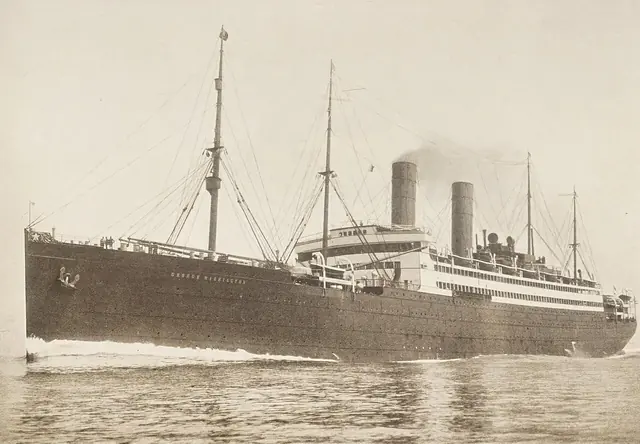
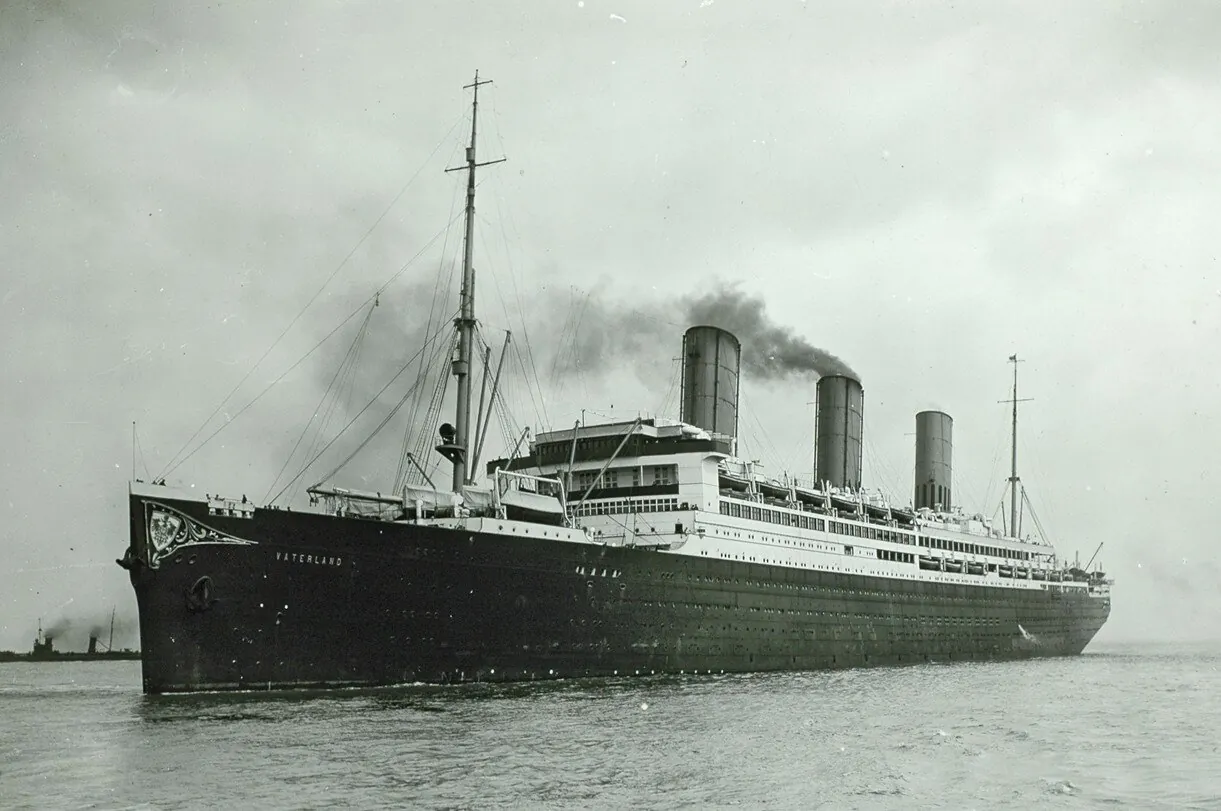
SS Vaterland was an ocean liner launched on 3 April 1913 that began service in 1914 for Germany's Hamburg America Line. The ship, second of three running mates and then the largest passenger ship in the world, made her first voyage to New York arriving on 21 May 1914 to celebrations featuring German and American officials at the line's Hoboken facilities.
The ship was designed to carry 4,050 passengers with most in third or fourth class. Those among the 700 first class and 600 second class passengers traveled in considerable luxury. The main public rooms took advantage of an unusual arrangement of the routing from boiler to stack along the sides rather than center to feature long and unbroken access from a replica of the New York Ritz-Carlton Restaurant main dining room forward to the lounge and ballroom aft. Vaterland served on the route for less than a year before being laid up at the line's piers in the neutral United States due to the start of World War I and risk of seizure by the Allies at sea.
With U.S. entry into WWI in 1917, Vaterland and the German line's Hoboken facility were seized by the US government. The ship was placed under the control of the United States Shipping Board. It was given July 1917 to the US Navy for completion of repairs and conversion to a troop ship. In July 1917 the ship was commissioned as USS Vaterland and on 6 September 1917 renamed USS Leviathan (ID-1326) and assigned to the Cruiser and Transport Force. The ship's first troop transport voyage departed New York on 17 December 1917 with 7,250 troops. At Liverpool, England, the ship spent fifty days in drydock, where her size was shown to be a problem, and the number of troops increased to 8,200. Further trips were destined for Brest, France, and the number of troops on board was incrementally increased to 10,500 by summer of 1918, which then expanded to 14,000 with double bunking. The ship's speed allowed transit without escort and often Leviathan and the fast ships SS Great Northern and SS Northern Pacific made the transit in company without escort. During the war the ship made ten round trips transporting more than 119,000 troops to Europe. That process was reversed after the war with the ship's last voyage with returning troops arriving on 8 September 1919. The ship was decommissioned and turned over to the Shipping Board on 29 October 1919, remaining laid up at Hoboken, NJ until April 1922.
At the end of the war there was a surplus of ships and a large number of Shipping Board sponsored companies. Leviathan was not only competing against that surplus but from lack of information such as blueprints from Germany, so that new ones had to be created by actual measurement of the ship. The ship was also caught up in controversies regarding the company originally agreeing to operate the ship.
Text: Wikipedia — SS Vaterland (1913), CC BY-SA 4.0
Follow Our Communities
Ship Facts & Specifications
Also Known As
- SS Leviathan