Other British Lines
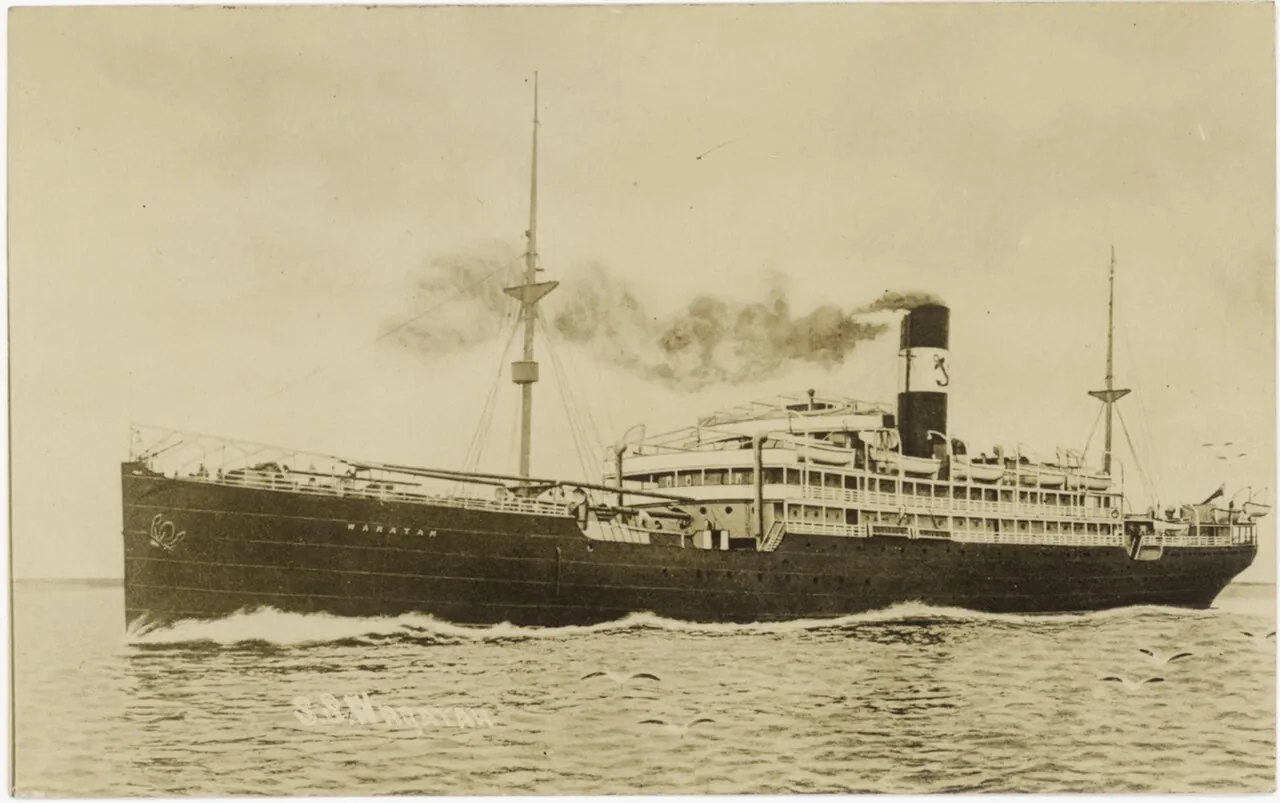
SS Waratah
Ship lost off South Africa in 1909
History
Waratah was a commercial steamship of the British Blue Anchor Line engaged in the transportation of passengers, cargo and mail between London and Sydney at the turn of the 20th century. On the night of 27–28 July 1909 and while on only her second voyage, Waratah, along with 92 passengers and a crew of 119, disappeared somewhere between Durban and Cape Town off the South African coast. No wreckage or remains have ever been found and Waratahs fate remains a mystery to this day.
On 15 September 1907, William Lund and Sons shipping company, doing business as the Blue Anchor Line, contracted with Barclay, Curle and Company shipbuilders of Glasgow to build what was to be their newest flagship. Credited with the design of the ship was Blue Anchor's managing director and son of the owner, Frederick William "Willie" Lund. However, Lund was not a naval architect and his design consisted of little more than taking the blueprints of the fleet's current flagship, Geelong, and making alterations. These intended modifications would make the new ship slightly larger than Geelong but substantially heavier and thus more costly, with a contracted pricetag of £139,900. Designated Yard No. 472, the ship was laid down at Barclay Curle's Clydeholm Yard in Whiteinch.
The vessel was specifically designed to capitalize on the booming immigration trade of working-class British people relocating to Australia. To meet the rising demand for low-cost passage to the Commonwealth, Lund proposed installing temporary dorms into the cargo holds, which when fully booked could accommodate an additional 500 third-class passengers. Then, upon reaching Sydney, the dorms would be dismantled and the holds converted back to cargo space for the thousands of tons of Australian wool and timber bound for overseas markets. Though innovative, this hybrid configuration necessitated a redistribution of weight throughout the ship (including the placement of her coal bunkers) and presented varying challenges to the ship's initial stability. With little grasp of the complexities inherent in his amalgamated design, Willie Lund also insisted that the new liner be "more stable than Geelong" while being able to shift in dock while carrying only water ballast and permanent coal. Though he tried to explain that these conditions were diametrically opposed, Noel Peck, managing director of Barclay Curle, offered a half-hearted placation to the junior partner by inserting the phrase "if possible" into the language of the contract. In the end, the architects at Barclay Curle assured the Lunds that a single stabililty curve plan would be sufficient for the loading, balancing and operation of the ship in either configuration. Lund's vacillations and the semantic arguments over the "if possible" condition dragged out construction and pushed delivery back by 38 days until late October. Per the terms of the contract, this delay entitled Blue Anchor to a demurrage of £50 per day for a total late fee of £1,900.
The liner was finally launched on 12 September 1908, with Elizabeth Ann Taverner, wife of Agent-General of Victoria John Taverner, serving as sponsor. William Lund had chosen to name his new flagship after the emblem flower of New South Wales, Australia; the chrysanthemum-like bloom Telopea speciosissim, also known by the Eora Aboriginal name Waratah. Waratah was 465 ft long between perpendiculars, 59 ft 4 in across her beam, with a mean draft of 30 ft. Her tonnages were 9,339 GRT, 6,004 NRT, and about 10,000 DWT. The vessel had a steel hull and was equipped with a pair of quadruple expansion engines, the cylinders of which measured 23 inches (58.4 cm), 32.5 inches (83 cm), 46.5 inches (118 cm) and 67 inched (170 cm) with a 48 in stroke. Combined, the engines produced 1,003 nhp to drive her twin propellers which gave the ship a top rated speed of 13+1/2 kn. Waratah had a cellular double bottom built along her entire length which included twin bilge keels to improve the ship's rolling. The hull itself was divided into seven watertight compartments. These protective measures led some newspaper pundits to proclaim Waratah "practically immune from any danger of sinking".
Text: Wikipedia — SS Waratah, CC BY-SA 4.0
Further Reading
Ship Facts & Specifications